International Matchmaking: From Basic Sites to Elite Agencies

HIGHLIGHTS:
- Many singles want to leave swipe-based apps, as AI-driven dating still fails to capture real chemistry.
- International matchmaking is booming as people look beyond borders for more compatible, meaningful relationships.
- Elite matchmaking services like Kelleher International and LUMA report client satisfaction rates of up to 82–88%, according to data published on their sites.
International matchmaking is redefining modern dating by shifting the focus from proximity to true compatibility. In a world where apps offer endless options but little clarity, more singles are turning to global, human-led search to find meaningful, lasting connections across borders. As a result, elite matchmaking is booming. In a world overloaded with digital options, more people are willing to invest in experts who can filter, curate, and introduce truly compatible partners.
The Global Shift: Why International Matchmaking is Growing
International matchmaking isn’t just trending — it’s scaling.
Over the past decade, cross-border relationships have moved from rare to remarkably common. Today:
- An increasing number of relationships in Western countries are starting online.
- International mobility has grown steadily, with millions living or working outside their birth country
- The global matchmaking and dating services market is valued in the multi-billion-dollar range.
But the real shift isn’t just digital — it’s psychological. Singles are widening their filters beyond city limits. Instead of asking, “Who’s nearby?” they’re asking, “Who’s compatible — anywhere in the world?”
What’s Driving the Growth?
Here’s a breakdown of the forces behind the rise of international matchmaking:
- Global Mobility — More remote workers, expats, and digital nomads
- Tech Expansion — AI-powered matching and global platforms
- Cultural Openness — Increasing acceptance of intercultural marriages
- Dating Fatigue — Many users report burnout from apps
In short: While 5 billion people are now digitally linked, our expectations have outpaced our reach. The world got smaller, but the "perfect match" just got a lot more complicated.
From Swiping to Strategic Matching
Let’s explore the evolution of global dating as a three-tier journey:
- Phase 1: Basic International Sites – Focuses on making global dating possible through open, large-scale platforms and self-discovery tools.
- Phase 2: Professional Agencies – Makes the process structured by introducing human assessment, verified data, and organized dating workflows.
- Phase 3: Elite Matchmaking – Reaches the pinnacle of being selective, offering bespoke matching, ultra-premium selections, and exclusive, highly curated opportunities.
As borders blur and standards rise, more singles are choosing intentional introductions over endless scrolling. International matchmaking is no longer about distance — it’s about precision. And in a world of 8+ billion people, precision matters.
International Matchmaking Services: What They Offer
While dating apps have been widely used by younger generations, many are now turning to professional search firms to find higher-quality matches. These agencies offer more than just a name — they provide a “human filter” and personal intuition that an algorithm simply can’t replicate.
Modern cross-border dating services have evolved far beyond simple profile browsing. Today’s platforms and agencies blend technology, psychology, and hands-on recruiting to deliver highly tailored introductions across continents. Here’s what they typically bring to the table:
Verified Compatibility: Unlike apps, where users often report trust issues with profiles, professional matchmakers offer rigorous vetting. This includes identity verification and deep-dive interviews to ensure “lifestyle alignment” (think: shared values over shared hobbies)
The "Headhunter" Edge: Elite agencies don't just wait for people to join their database. They actively "scout" for you, acting like executive recruiters but for your heart.
Concierge Romance: From booking your flight to Tokyo to arranging a candlelit dinner in Paris, top-tier services handle the logistics so you can focus on the chemistry.
According to data published by Pew Research Center , attitudes toward intercultural relationships have steadily increased over the past two decades, particularly among professionals under 40.
Today’s international matchmaking services offer far more than digital introductions. They provide structure, vetting, coaching, and logistical support — transforming what used to be chance encounters into strategic, carefully managed connections across borders.
With thousands of matchmakers working worldwide, it’s clear that international matchmaking is about more than borders. Today, it’s about bringing the right people together in the right way — starting with your attraction archetype. Understanding how you connect emotionally and physically helps you spot the right matches, avoid mismatches, and make dating more intentional and rewarding.

Behind the Scenes: How Global Agencies Actually Work
Ever wondered what really happens after you sign the contract? It’s far less “rom-com magic” and far more structured process, metrics, and quiet logistics.
1. Client Intake: More Psychology Than Profile Photos
The journey usually starts with a 60–120 minute deep-dive interview. Top-tier agencies gather data on:
- Relationship history
- Core values & non-negotiables
- Lifestyle expectations (relocation, children, career priorities)
- Cultural flexibility
Many firms use personality models inspired by frameworks developed by organizations like The Myers-Briggs Company to map compatibility patterns. Top-tier matchmakers don’t take everyone — they prioritize clients who are serious about finding a lasting relationship
Typical onboarding timeline:
2. Recruitment: Active Search, Not Passive Browsing
Global agencies often conduct active recruitment. This includes:
- Private databases
- Professional networking events
- Referral networks
- On-the-ground scouts in key cities
In major hubs like New York City, London, and Dubai, agencies maintain local partners who pre-screen candidates before introductions are ever made.
Average internal search metrics:
- 20–50 profiles reviewed for every 1 introduction
- 5–15 hours spent vetting a single candidate
- 2–4 weeks per curated match cycle
3. The Matching Algorithm + Human Filter
Data matters — but instinct seals the deal. Many firms combine:
- 100–200 question compatibility assessments
- Cultural adaptability scoring
- Long-distance readiness index
- Lifestyle alignment percentage
Algorithms narrow options, but final decisions often rest with a senior matchmaker who has reviewed hundreds (sometimes thousands) of successful pairings.
It’s a bit like a venture capital model: invest in fewer, higher-probability matches rather than mass exposure.
4. Post-Date Feedback Loop
Here’s where many people are surprised: feedback is mandatory.
After each introduction:
- Both parties submit structured feedback forms
- Matchmakers analyze patterns
- Criteria are refined
- Search parameters are adjusted
This iterative model increases efficiency over time. Leading agencies observe that compatibility often improves with each introduction, particularly by the second or third match.
5. Success Metrics (Yes, They Track Them)
Behind closed doors, serious firms monitor KPIs such as:
- Introduction-to-second-date ratio
- Engagement rate within 12–24 months
- Average time to exclusive relationship
While numbers vary, boutique agencies often aim for 6–18 months average time-to-partnership for committed clients.
It’s not just about the person; it’s about the experience. A significant part of their work now involves handling international logistics — booking private villas in Tuscany or arranging “blind date” travel itineraries. They remove the “administrative burden” of dating, allowing you to walk into a room where the only thing you have to worry about is the chemistry.
Digital vs. Personal: Comparing Sites and Private Search
Choosing between an international dating site and a private matchmaking firm is a bit like comparing online shopping to a personal stylist. Both can work — but the experience (and outcomes) look very different.
Let’s break it down with numbers.
1. Scale vs. Selectivity
Large platforms owned by companies like Match Group operate at massive scale, managing tens of millions of users worldwide across multiple apps. But more choice doesn’t always mean better odds. Behavioral patterns on swipe-based apps show that users often engage with only a small portion of the profiles they browse.
2. Algorithm vs. Human Strategy
Platforms like eHarmony popularized structured compatibility scoring with long-form questionnaires (often 100+ questions). Today, most apps rely heavily on behavioral data: swipes, clicks, time spent viewing profiles.
Private search models combine:
- Psychological interviews (60–120 minutes)
- Lifestyle alignment analysis
- Cultural readiness evaluation
- Direct recruiter sourcing
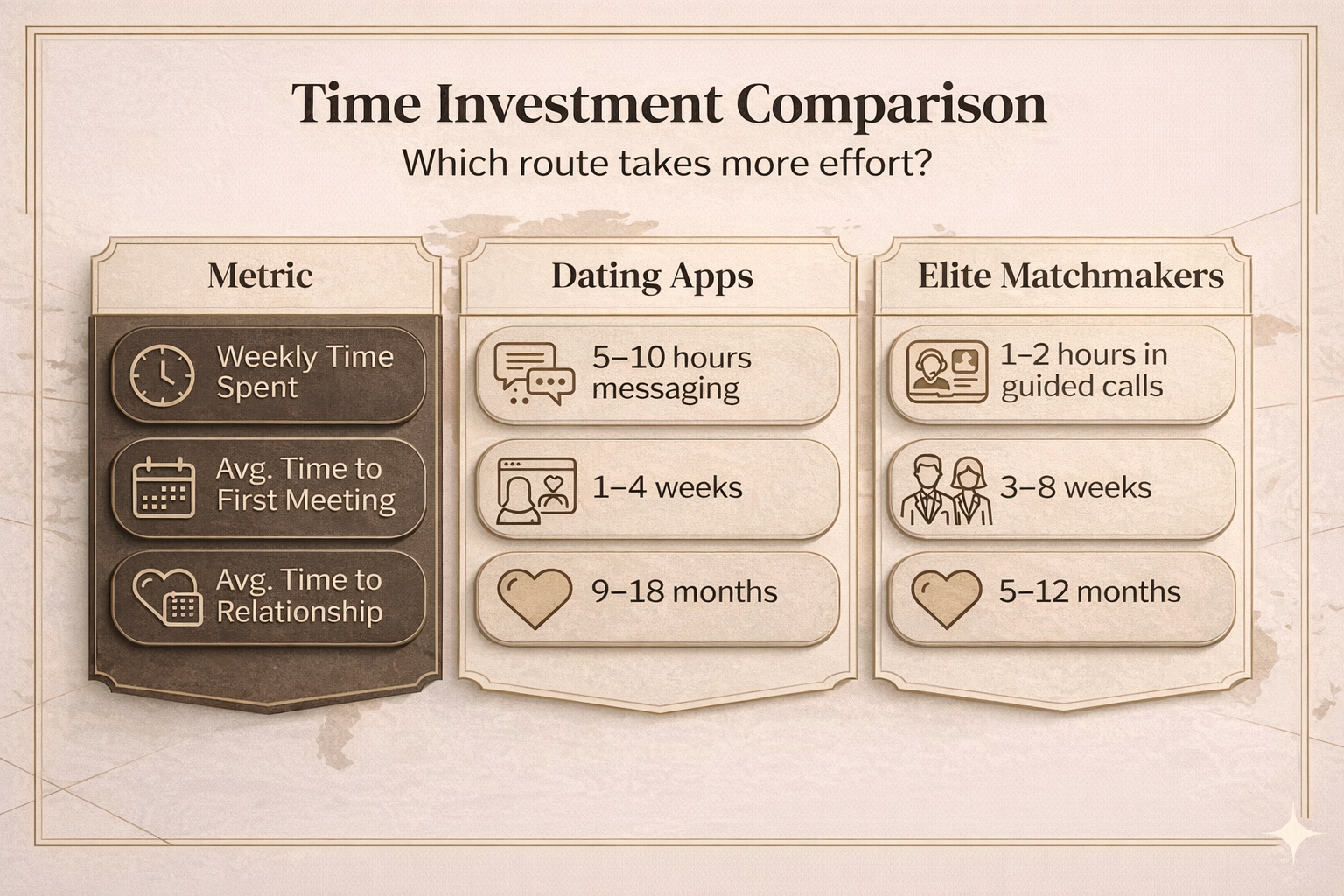
3. Time Investment Comparison
Which route takes more effort? We compared the typical time investment of self-managed dating apps against a curated search strategy. This comparison highlights the shift from the 10-hour-a-week 'messaging grind' to a streamlined, executive-search model, as illustrated in the time audit below.
4. Cost vs. Commitment
Here’s where the gap becomes obvious.
- Dating apps: $20–$60 per month for premium tiers
- High-end global search services: $5,000–$50,000+ annually
The pricing difference naturally filters intent. Agencies report that clients investing at higher tiers tend to show stronger follow-through on meetings compared to the lower commitment often seen on open platforms.
5. Privacy & Discretion
On apps:
- Your profile may be visible to thousands.
- Screenshots happen.
- Search algorithms decide exposure.
With private matchmaking firms:
- Profiles are shared one-to-one.
- NDAs may be used for high-profile clients.
- Public visibility is minimal.
For executives, entrepreneurs, and public figures, this discretion is often a deciding factor.
So… Which Wins?
It’s not about better or worse — it’s about fit.
- If you enjoy exploration, high volume, and control — digital platforms offer freedom and scale.
- If you prefer precision, vetting, and guided strategy — private search delivers focus and structure.
In the landscape of international matchmaking: from basic sites to elite agencies, the real difference isn’t geography — it’s methodology. One runs on volume and velocity. The other runs on curation and commitment.
Is Elite International Matchmaking Worth the Investment?
Let’s be real: when the price tag of a service rivals the cost of a luxury SUV, you aren’t just looking for a date — you’re looking for a return on your most precious asset: time. Today high-net-worth singles are increasingly viewing high-end search firms as "Lifestyle Insurance."
But does the math actually add up? Let’s look at the "Love ROI" (Return on Investment) for the elite tier.
Elite matchmaking services can vary widely in price depending on the level of personalization, region, and included features.
- Local Matchmaking — $15,000–$30,000
- National VIP — $45,000–$75,000
- Global Elite — $150,000–$300,000+
By the Numbers: Efficiency vs. Expense
Let’s assume, for the sake of argument, that the average professional earns between $200 and $500 per hour. When you factor in the “App Tax”—the sheer amount of time lost to dead-end conversations — the “expensive” agency starts to look like a bargain.
- The Time Audit: The average app user spends about 90 minutes a day on platforms like Tinder, based on publicly available usage data. Over a year, that is 547 hours. If we value your time at, for example, $200 per hour, you’ve effectively “spent” $109,400 on an algorithm where fewer than 10% of matches lead to meaningful relationships, based on data from Pew Research Center.
- The Agency Edge: Top-tier firms like Kelleher International and LUMA report client satisfaction rates between 82% and 88%, based on data published on their official websites. Most of their clients find a committed partner within the first 3 to 4 introductions.
- The "Vetting" Premium: In a world of AI-generated profiles and deepfakes, elite agencies invest heavily in identity verification and multi-state background checks.
The Intangible ROI: Why it’s Worth It
If your net worth is growing but your personal life is stagnant, the investment is usually worth it. You are essentially hiring a "Chief Love Officer" to manage an important merger of your life.
While elite matchmaking offers curated, high-quality connections, it comes with downsides you should remember: high costs, a limited pool of potential matches, over-curation that can stifle natural chemistry, and the emotional pressure of a highly selective process. Success isn’t guaranteed, and the time and emotional investment may sometimes outweigh the benefits.
Lessons from the Inside: Red Flags I’ve Learned to Spot
After reviewing 35+ international matchmaking sites, clear warning patterns start to emerge. While glossy photos and bold promises dominate landing pages, the real signals lie in the numbers, policies, and behavioral patterns behind the scenes.
🚩 Red Flag #1: Vague Success Metrics
If a platform claims “thousands of happy couples” but publishes zero verifiable statistics, that’s a concern. Reputable services often share measurable indicators such as:
- published success rate
- verified member identity rate
- avg. response time (agency-led)
- refund policy clarity
🚩 Red Flag #2: Too-Good-To-Be-True Demographics
If a platform promotes an unusually narrow age range or overly uniform member profile that doesn’t align with broader demographic realities, it’s worth approaching with skepticism. Authentic databases tend to reflect a more balanced age distribution and diverse professional backgrounds.
🚩 Red Flag #3: No Human Oversight
Elite agencies usually assign 1 matchmaker per 10–25 active clients. If there’s no visible human involvement — no interviews, no cultural briefings, no background screening — you’re likely dealing with automation rather than curated introductions.
🚩 Red Flag #4: Emotional Acceleration
Behavioral analysis from client case studies shows that requests for financial help or urgent travel plans within the first 7–14 days of contact correlate strongly with scam indicators. Healthy connections develop gradually.
In short: Transparency beats promises. Matchmaking services that openly share data, screening processes, and realistic timelines consistently outperform those relying solely on marketing language. Numbers rarely lie, but vague promises often do.
Conclusion: Is This Path Right for You?
Approaching international matchmaking requires strategy, not romantic impulse. The numbers show that preparation, transparency, and realistic timelines consistently separate rewarding experiences from frustrating ones.
You might be a good fit for international matchmaking if:
- You value long-term compatibility over casual dating
- You’re comfortable navigating different cultures
- You see travel as an opportunity, not a burden
- You’re patient with the process.
You may want to reconsider if:
- You expect instant chemistry without effort
- You’re unwilling to meet in person
- You’re looking for validation rather than commitment.
If you’re ready to invest time, emotional energy, and thoughtful intention, this path isn’t just about meeting someone abroad — it’s about expanding your definition of partnership itself.
FAQs About International Matchmaking
Stepping into the world of borderless romance is a big move, and it's natural to have a spreadsheet's worth of questions. Here’s the data-driven lowdown on what to expect when you take your search for "The One" global.
How much does international matchmaking actually cost?
The price tag varies wildly depending on whether you’re browsing a database or hiring a private investigator for your heart. In 2026, the market has split into three distinct tiers:
- The "DIY" Entry Level ($30 – $100/mo): Basic sites and apps. You handle the vetting, the translations, and the travel logistics.
- The Mid-Range Boutique ($5,000 – $25,000): Regional agencies that provide human-led searches, basic background checks, and coached introductions.
- The Elite International Matchmaking Service ($30,000 – $150,000+): Full-service "headhunting" for love. This often includes international scouting, private concierge services, and even styling.
Is it safe to meet someone from another country through an agency?
While dating apps often face issues with fraudulent profiles, elite agencies aim for complete authenticity. Legitimate services implement a “multi-factor” vetting process:
- Identity Verification: Reputable agencies usually require government-issued ID to confirm member identities during onboarding.
- Vetting Interviews: At least 2–3 hours of deep-dive interviews to ensure intentions match the profile.
- Physical Safety: Most high-end firms coordinate first dates in public, verified venues, significantly reducing the risk of “catfishing” or safety incidents compared to unmonitored apps.
How long does it typically take to find a serious partner?
There’s no magic number — but averages give useful benchmarks:
- Elite Matchmaking — 5–12 months
- Local Matchmakers — 3–9 months
- Dating Sites & Apps — 6–18 months.
What happens if I don't feel a connection with my matches?
Don’t panic — it’s part of the process. Feedback loops are built into most contracts, often through post-date debriefs where your matchmaker uses your input to recalibrate and refine future matches. Many elite agreements also include a “freeze” option, allowing for a 3 to 12-month hold period. This means that if you need a break or decide to focus on one connection more deeply, your investment remains protected.
Do these services help with visas or legal paperwork?
Most matchmakers are experts in chemistry, not constitutional law. While they don't typically act as lawyers, they provide the "Evidence of Relationship" crucial for legal filings.
Agencies cannot guarantee legal outcomes (like visa approval), but reputable ones make the process less confusing by offering checklists, translation help, and lawyer introductions.
Noncommercial sharing of this article is permitted, provided you include full attribution and a link back to Last Matchmaker.