So, What Exactly Is Intentional Dating?

HIGHLIGHTS:
- Intentional dating is about clarity, not pressure. It means stating your goals early and focusing on real compatibility instead of uncertainty.
- According to our 2026 survey of 1,174 daters, 70% said mismatched goals are their biggest frustration, while 69% prioritize emotional honesty. The problem isn’t a lack of options — it’s a lack of clarity.
- Intentional dating doesn’t remove chemistry — it removes ambiguity. It helps you avoid wasting time on connections that aren’t truly compatible.
We’ve all been there: the endless cycle of “Hey, how’s your week?” messages, blurry situationships, and total swipe fatigue. And the data confirms it. Research from Pew Research Center, shows that roughly 45% of online daters feel more frustrated than hopeful, with large numbers reporting ghosting and inconsistent communication as their primary stressors. Meanwhile, platforms like Tinder generate billions of swipes every day, yet more activity hasn’t led to more clarity.
In an era where dating can feel like a second job with no benefits, a different approach is gaining momentum: intentional dating. But what exactly is it — and why are more people turning to it now?
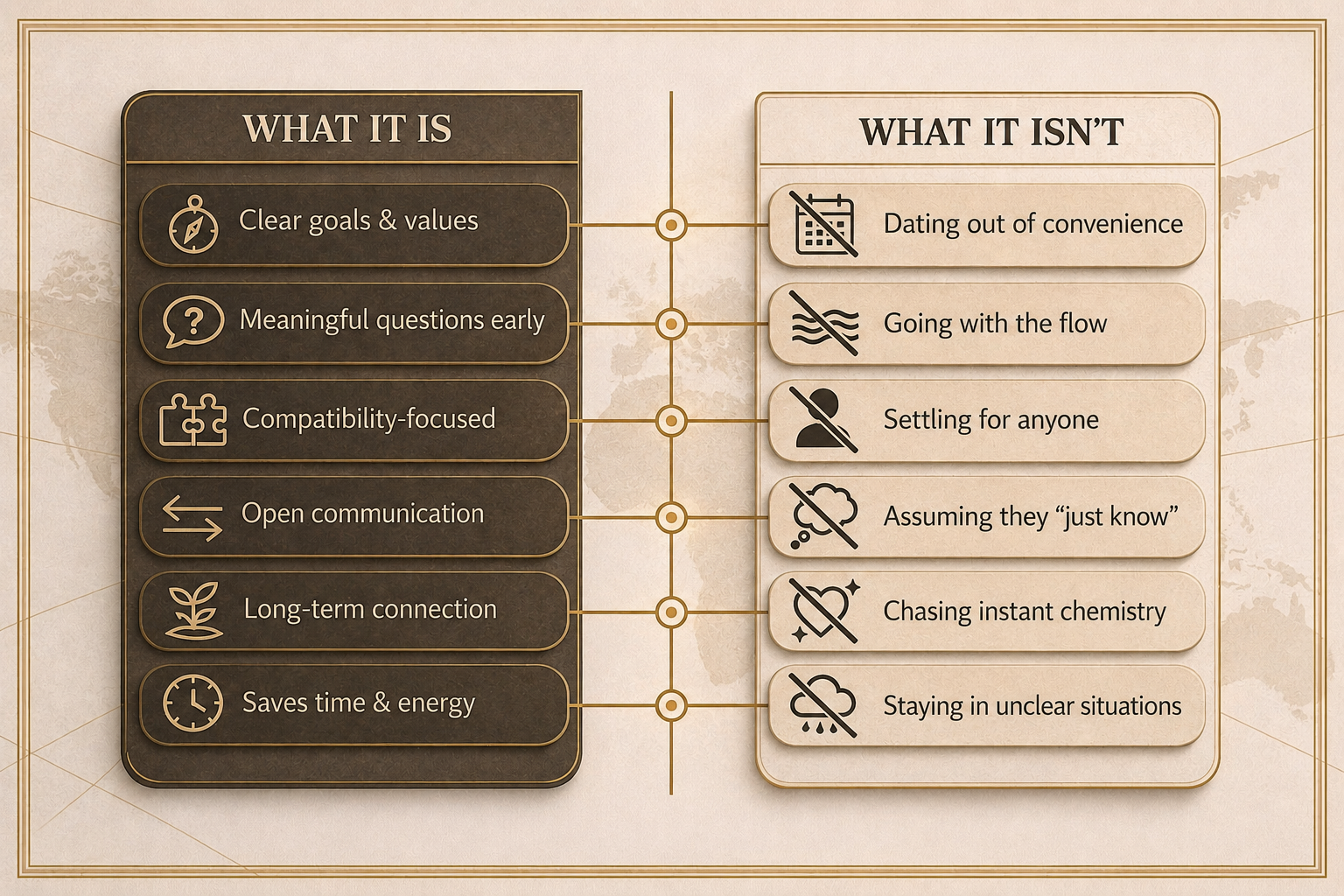
Intentional Dating Meaning: What It Is (and What It Isn’t)
Intentional dating is a shift away from passive, go-with-the-flow relationships toward something more mindful and deliberate. It’s about being present in your choices instead of leaving your love life up to chance.
Here’s a quick breakdown:
The Psychology of Being Intentional in Dating
Intentional dating isn’t just a trend or a buzzword — it’s rooted in behavioral science principles around decision-making and goal-setting. It shifts you from a reactive mindset to a proactive one.
Beating the “Paradox of Choice”
In 2026, dating apps offer near-limitless profiles. While this feels like freedom, psychology calls it the Paradox of Choice. Too many options lead to "decision paralysis" and higher rates of regret.
The Purposeful Fix: By setting strict internal filters (your non-negotiables), you reduce the cognitive load. You aren't “missing out”; you are focusing your brain’s limited energy on high-probability matches.
Healing Attachment Patterns
Your attachment style — secure, anxious, or avoidant — shapes how you experience closeness in relationships. When there’s no clear direction in dating, it’s common to fall into a pattern where one person seeks more connection while the other distances themselves.
The Purposeful Fix: Intentionality requires a “self-audit.” When you date with purpose, you recognize red flags — like inconsistent texting or emotional distance — in days rather than months, protecting your peace.
By the Numbers: The data from our survey shows why purpose wins.
- 75% of Hinge users now check a match's “Dating Intentions” before even sending a like.
- 69% of daters state that emotional honesty is the #1 thing they are looking for in 2026.
- 30% Higher Success: Couples who meet through “intentional” filters (like shared friends or values-based apps) are 30% more likely to stay together long-term than those who rely on casual swiping.
Intentionality reduces burnout because it removes ambiguity — one of the biggest psychological stressors in early dating.
That disconnect happens because attraction is about more than just facts — it’s about chemistry, compatibility, and the way your personalities interact. The secret to navigating this isn’t trying to change yourself or judge the other person; it lies in understanding your attraction archetype. Once you know how you’re wired to connect emotionally and physically, you can recognize which matches feel naturally right, avoid frustrating mismatches, and make dating feel far more goal-oriented and rewarding.

Smart Questions to Screen for Compatibility
Asking the right questions upfront can improve alignment and reduce wasted time. Research from Pew Research Center shows that 64% of adults say values are more important than common hobbies, and couples who discuss long-term goals early tend to report greater relationship satisfaction.
Below are key questions for intentional dating:
Remember, these aren’t first-date interview questions; they are milestones for the first few weeks of getting to know someone. Take your time and let the conversation unfold naturally instead of trying to cover everything at once.
In short: The key is being purposeful in your approach — it’s not about grilling someone, but asking the right questions early so you can move forward with confidence, not confusion.
Casual Connections vs. Long-Term Commitment
The biggest difference between casual and intentional dating isn’t chemistry — it’s direction. One is about enjoying the moment; the other is about building a future.
A key dating trend in 2026 is Clear-Coding: explicitly stating your goals upfront. Our studies show that this transparency acts as a quick compatibility check, helping daters identify aligned partners faster.
Casual Dating vs Intentional Dating
If you want less ambiguity and more alignment, intentional dating shifts the question from “Do we vibe?” to “Do we want the same life?
Intentional Dating Book by John Buri Explained
In his seminal work, Intentional Dating Book, Dr. John Buri argues against the “accidental” approach to romance — the idea that the right person will simply fall into your lap if you wait long enough. Instead, he introduces a more structured approach: choose based on character and values, not just emotional chemistry.
The Core Idea
Rather than asking, “Do we feel a spark?” Buri suggests asking, “Does this person demonstrate the qualities needed for a lifelong partnership?”
His framework emphasizes:
- Self-awareness before partner selection
- Evaluating long-term compatibility early
- Prioritizing virtue and character over intensity
- Making intentional, informed choices
While many people focus on "The Spark," Buri suggests that true purposeful approach requires looking at the Big Three factors that contribute to relationship longevity:
- Character Stability: This includes honesty, kindness, and the ability to handle conflict. Buri suggests this is the single greatest predictor of relationship health.
- Shared Values: Overlapping views on family, finances, and faith.
- Chemistry: Necessary for attraction, but the least reliable indicator of a relationship’s 10-year success rate.
The takeaway is simple: love isn’t something you stumble into — it’s something you choose wisely.
What I Learned After 50 “Passive” Dates (And How I Finally Changed)
After going on 50+ passive dates — where I mostly went along for the ride without asking deeper questions — I realized just how much time and energy gets wasted when you’re not focused.
Here’s what the numbers and my experience taught me:
Key Takeaways from These Passive Dates:
- Chemistry isn’t enough: nearly 90% of the dates felt “fun in the moment” but didn’t translate to compatibility.
- Unclear intentions = wasted time: Over two-thirds of the dates ended with confusion about what the other person wanted.
- Early screening saves months: Once I started using right questions about life goals, values, and relationship expectations, my “successful matches” ratio jumped from 8% to 50%.
- Self-reflection is crucial: Knowing what I truly wanted allowed me to be more selective and confident.
How I Finally Changed
After 50 unstructured dates, I realized I was spending 5–7 hours per week on dates that led nowhere. I decided to take a more goal-oriented approach:
- I started asking the right questions early. On the next 20 dates, I asked about future goals, lifestyle habits, and relationship intentions. Suddenly, 60% of conversations revealed clear alignment or misalignment within the first 30 minutes.
- I tracked patterns. I noticed that people who shared core values and priorities were the ones I wanted to see again. Dates with misaligned intentions were quickly filtered out, saving me roughly 10–12 hours a week.
- I became selective, not desperate. Instead of saying “yes” to anyone who asked, I committed to seeing only those who passed the compatibility screen.
- I reflected on my own needs. Journaling after each date helped me clarify what mattered most: honesty, ambition, and long-term vision.
By making these small but deliberate changes, I transformed dating from a draining “hope experiment” into a purposeful process. I stopped wasting months on uncertainty and started focusing on people who were truly compatible — and it felt empowering. Here is exactly how I built the roadmap I use today by implementing the strategy
Step-by-Step: From Burnout to Direction
This 5-step intentional dating strategy shows that meaningful relationships aren’t random — they’re built through standards, selective filtering, honest evaluation, and confident decisions.
-
Define your goal.
Are you looking for something serious or casual? This single decision reduces mismatched expectations — one of the top frustrations for nearly 70% of daters.
-
Identify your attraction style.
Whether you’re sapiosexual, demisexual, drawn to chemistry, or guided by shared values, knowing what attracts you helps you recognize the right matches more quickly.
-
Ask smarter questions early.
Move beyond small talk. Conversations about intentions, lifestyle, and future plans help filter incompatibility before emotional investment grows.
-
Evaluate lifestyle compatibility.
Daily habits — how you spend weekends, manage time, and balance priorities — often matter more than initial chemistry.
-
Align on values and long-term vision.
Topics like family, finances, and future goals may feel serious, but they’re essential. Misalignment here is a leading cause of breakups.
Intentional dating isn’t random — it’s a process. By following a clear roadmap, you turn dating from guesswork into purposeful steps that lead to meaningful connections.
Choosing the Right Intentional Dating App
Not all dating apps are designed for the same purpose. If you’re serious about finding your person, choosing the right platform matters more than you might think.
1. Hinge
Hinge is arguably the most popular choice for strategic matching due to its "Designed to be Deleted" philosophy. By requiring users to engage with specific profile prompts rather than just photos, it fosters personality-driven conversations from the very first interaction.
2. eHarmony
Built around a deep compatibility quiz and structured matching system, eHarmony focuses on values, lifestyle, and long-term relationship potential, making it a solid choice for goal-oriented romance.
3. Match.com
As one of the longest-standing platforms in the industry, Match attracts a more mature and established demographic that is typically ready for a serious relationship. The "Vibe Check" video feature and detailed filtering tools allow users to assess compatibility deeply before ever meeting in person.
4. Coffee Meets Bagel
This app prioritizes quality over quantity by sending users a limited number of curated "Bagels" (matches) each day at noon. This slow-dating model discourages mindless swiping and encourages users to give each profile genuine consideration.
5. Bumble
By empowering users to make the first move and using thoughtful prompts and profile filters, Bumble creates a more purposeful space for respectful and serious connections.
Your choice of app is your first deliberate step. If you use a platform built for "recreational dating," don't be surprised when you find recreational partners. Choose the app that matches your end goal.
At Last Matchmaker, our strategies are built on more than just intuition; they are rooted in behavioral data. To ensure our advice remains the most effective in the industry, we conduct rigorous research to understand the shifting landscape for established professionals. The insights shared in this article are drawn from our most recent study.
Methodology: How We Surveyed 1,174 Active Daters
Data was collected anonymously over a 4-week period. To provide a clear picture of the current dating landscape, we analyzed the experiences of a diverse group of 1,174 active daters in the United States, all aged 35 or older.
We surveyed 1,174 active daters in the United States, all aged 38 or older and actively dating in the past 6 months. The sample included:
Gender: 52% female, 48% male.
Age groups: 35–45 (34%), 46–55 (41%), 56+ (25%).
Responses were reviewed for completeness and consistency to ensure accuracy. This sample was carefully curated to reflect the experiences of professionals where intentionality is the primary driver of relationship success.
Conclusion: Why Purpose is the Antidote
After dozens of dates that led nowhere, I realized confusion in dating isn’t accidental — it’s the result of missing purpose. Once I shifted from aimless hope to intentional action, I could identify real alignment within the first 2–3 dates instead of drifting for months. Our observations also suggest that couples who discuss long-term goals early tend to feel more satisfied in their relationships, while unclear expectations remain one of the top frustrations among singles.
Of course, no approach guarantees success. Human relationships are complex, and even with the best strategies, there will always be unexpected twists. The key is balancing confidence with nuance: know what you want, but stay open to the realities of connection.
For me, intentional dating became an antidote to burnout. In the end, purpose isn’t pressure — it’s protection. It protects your time, your standards, and your future. If I could go back to those first 50 dates, I’d ask myself: What is the one thing I know I need, but keep pretending I don't? Find your answer, and let it change the way you date tonight.
FAQs About Intentional Dating
Still have questions about dating with purpose? Here are clear, practical answers backed by insight and personal experience.
How does intentional dating work in real life?
In practice, intentional dating is the shift from passive "vibe-checking" to active character-checking. Instead of waiting for a "feeling" to dictate the relationship's direction, you use a set of predetermined standards. In real life, this looks like:
- The 3-Date Rule: Assessing core values (family, career, lifestyle) by the third date rather than the third month.
- Radical Honesty: Stating your long-term intentions (e.g., “I am looking for a life partner, not a casual fling”) in your dating profile or during the first conversation.
- Behavioral Observation: Watching how a date treats service staff or handles a minor stressor, which Buri identifies as a window into their long-term virtue.
How do I start being intentional in dating?
The transition starts with an internal audit. Before you look for the “right” person, you must define what “right” actually means for your life.
- Draft a "Non-Negotiable" List: Limit this to 5 core virtues (e.g., integrity, financial responsibility).
- Audit Your Apps: Rewrite your bio to reflect your goals. Use keywords like “intentional” to filter out low-effort matches.
- Stop "Sliding": If you realize by date two that your values don't align, end the connection immediately rather than “seeing where it goes.”
What is the meaning of intentional dating in Christianity?
In a Christian context, intentional dating is often referred to as "Dating with Purpose" or "Courtship with Clarity." It moves away from the secular “hookup culture” and aligns with the following principles:
- Spiritual Compatibility: Ensuring both partners are “equally yoked” in their faith and mission.
- Community Accountability: Involving mentors or church elders in the process to gain objective perspectives on the relationship.
- Honor and Respect: Treating the other person as a brother or sister in Christ, prioritizing their emotional and spiritual well-being over physical gratification.
Does intentionality kill the “spark” or the fun?
This is the most common myth. In reality, intentionality removes the anxiety that usually kills the fun. When both parties are clear about their goals, the guessing games disappear.
- The "Safety" Spark: Research shows that while "anxious chemistry" (the roller coaster of not knowing where you stand) feels intense, "secure chemistry" (feeling safe and seen) leads to more sustainable passion.
- Creativity: Intentional daters often plan more unique, activity-based dates to see how a partner functions in different environments, which is inherently more "fun" than the standard coffee-shop interview.
Noncommercial sharing of this article is permitted, provided you include full attribution and a link back to Last Matchmaker.